


Immigration Around the World
ACCENTUATE! | INAUGURAL EDITION
January–October 2026 | Outlook: November–December 2026
Around the Globe: Immigration Policy and People
Around the world, immigration policies continue to evolve, shaping workforce mobility, compliance obligations, talent pipelines, humanitarian protections, and the lived experiences of immigrants and refugees. The Accentuate! Global Immigration Monitor highlights notable developments across regions, helping employers, HR leaders, educators, nonprofit organizations, and globally mobile professionals stay informed about changing policies and their implications for people and organizations.
Effective | Announced | Proposed
Effective = in force · Announced = officially confirmed for future implementation · Proposed = not yet enacted.
Canada
✳︎
European Union
✳︎
United Kingdom
✳︎
Asia
✳︎
Africa
✳︎
Middle East
✳︎
Caribbean
✳︎
Latin America
✳︎
Oceania
✳︎
Canada ✳︎ European Union ✳︎ United Kingdom ✳︎ Asia ✳︎ Africa ✳︎ Middle East ✳︎ Caribbean ✳︎ Latin America ✳︎ Oceania ✳︎
Regional Highlights
Canada | Effective
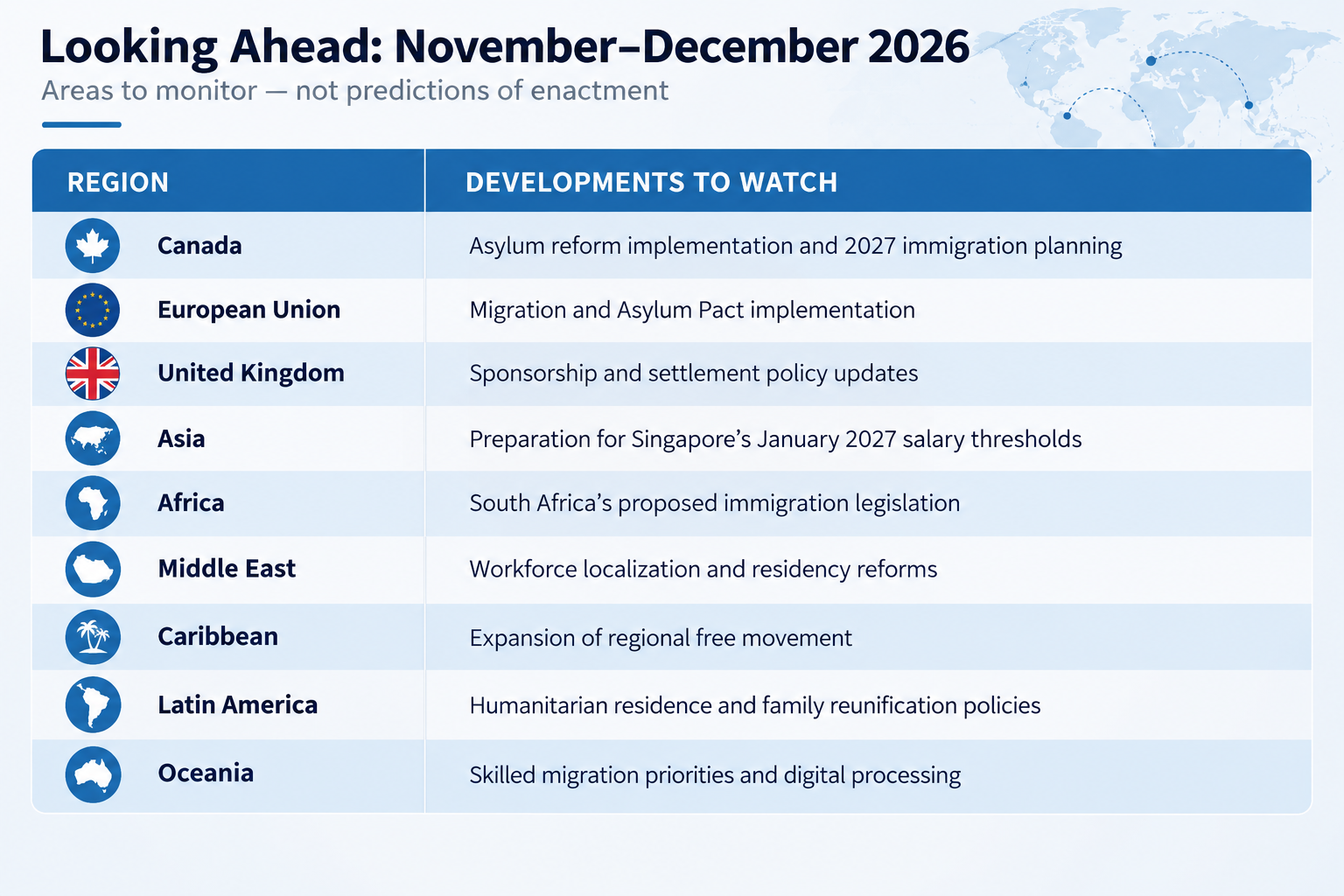
Bill C-12 became law on March 26, 2026, introducing new asylum eligibility restrictions, information-sharing provisions, and expanded immigration document authorities. Additional asylum-processing regulations were proposed in June.
Employer & Humanitarian Signal: Compliance Risk + Access to Protection.
European Union | Effective
The EU Migration and Asylum Pact entered into application on June 12, 2026. It introduced common border-screening procedures, revised asylum processes, and a solidarity mechanism among member states. National implementation continues.
Employer & Humanitarian Signal: Regulatory Change + Refugee Protection.
United Kingdom | Effective
Immigration rule changes took effect in January 2026, including amendments affecting Skilled Worker and other work-related visa routes. Employers must continue reviewing sponsorship eligibility, applicant requirements, and compliance procedures under the updated rules.
Employer Signal: Sponsorship Compliance + International Recruitment.
Asia — Singapore | Announced
Singapore announced higher Employment Pass and S Pass qualifying salary thresholds in March 2026. New thresholds begin January 2027 for new applications and January 2028 for renewals. Existing salary requirements remain applicable in the meantime.
Employer Signal: Rising Sponsorship Costs + Workforce Planning.
Africa — South Africa | Proposed
South Africa's Cabinet approved a revised White Paper on Citizenship, Immigration and Refugee Protection in March 2026. The policy proposes legislative consolidation, digital modernization, and changes to immigration and refugee protection. The proposed statutory reforms are not yet enacted.
Employer & Humanitarian Signal: Immigration Reform + Policy Transition.
Middle East — Saudi Arabia | Effective
Saudi Arabia increased the localization requirement to 30% across 46 engineering professions, effective June 30, 2026, for covered private-sector employers with five or more employees in those professions. The labor-market measure affects foreign-worker recruitment and workforce planning.
Employer Signal: Workforce Localization + Hiring Compliance.
Caribbean — CARICOM | Effective
Expanded free movement among Barbados, Belize, Dominica, and St. Vincent and the Grenadines continued through 2026. Participating nationals can live and work across the four states without work permits under the arrangement. CARICOM reported 939 people processed during its first year.
Employer Signal: Regional Mobility + Workforce Opportunity.
Latin America — Brazil | Effective
Brazil adopted new humanitarian migration measures in 2026, including provisions for Afghan nationals and stateless persons, amendments to family reunification arrangements for eligible Haitians, and a simplified family reunification process for recognized refugees.
Humanitarian Signal: Family Reunification + Access to Protection.
Oceania — Australia & New Zealand | Effective
Australia introduced revised skilled visa processing priorities effective September 19, 2026. New Zealand moved selected visitor and transit visa applications to its enhanced online system beginning October 1, supporting the transition toward digital immigration processing.
Employer Signal: Skilled Migration + Administrative Compliance.
Employer Lens: Why These Developments Matter
The developments highlight implications for international recruitment, sponsorship planning, immigration costs, workforce mobility, and regulatory compliance. For employers and institutions, distinguishing enacted policies from announced or proposed changes is essential for informed decision-making.
Refugee & Humanitarian Watch
Canada's asylum restrictions, the EU's revised asylum framework, and Brazil's humanitarian migration provisions demonstrate the different approaches governments are taking toward protection and migration management. Beyond the legal changes are individuals and families navigating uncertainty, displacement, and opportunities to rebuild their lives.
Strategic Takeaway
Immigration policy is not simply about who may cross a border. It shapes who can work, study, reunite with family, seek protection, and build a future. Understanding these developments helps organizations plan responsibly while recognizing the people whose lives are affected.
Disclaimer: Information current as of October 23, 2026. This selective global overview is provided for general awareness and is not legal advice. Immigration laws and procedures may change; consult official government sources for current requirements.